Handle email, meetings, travel and paperwork, and coordinate with other people’s agents.
Swarms of agents
Thousands of agents working together for days.
Cyberattacks
Nation-state hacking capability in open models, for anyone. Grocery stores and other poorly protected local infrastructure lie open. Now.
Warning shot 2.0
Like the Hugging Face incident, but worse. Very likely unless we do more.
Last briefing · 14 October
Since last time
Four weeks in the news
The Guardian
Websites across world hit by millions of attempts to exploit PHP code flaw
Al Jazeera
Binance says $6.3bn stolen in biggest crypto heist in history
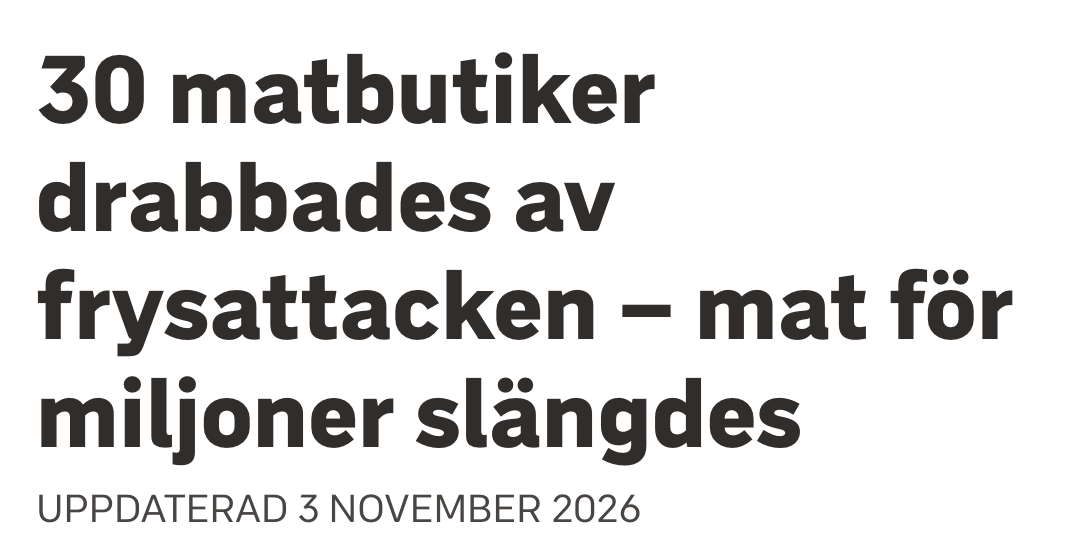
SVT
30 grocery stores hit by the freezer attack – food worth millions thrown away
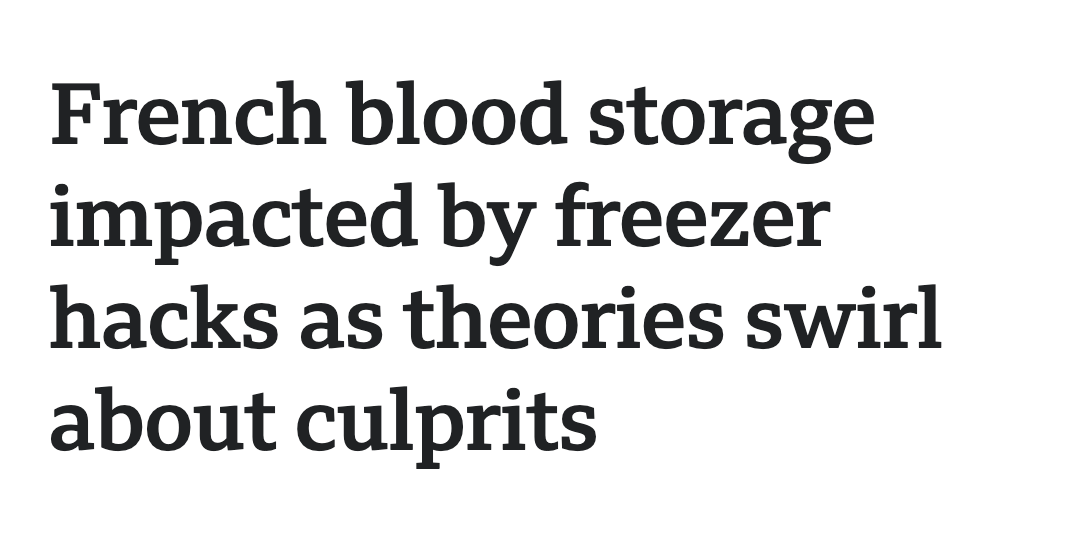
BBC
French blood storage impacted by freezer hacks as theories swirl about culprits
SvD
“Darwinian demon” could wipe out humanity
CBS News
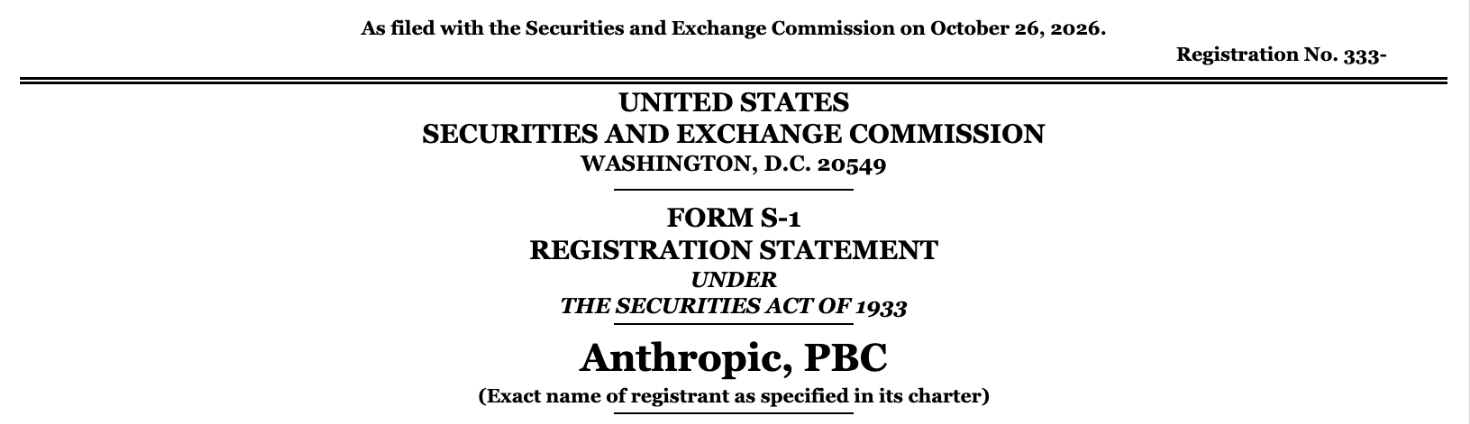
Anthropic’s IPO filing lists 93 pages of risks. What could possibly go wrong?
TechCrunch
Frontier AI labs say their models refuted the Exponential Time Hypothesis
The Guardian
AI-powered malware ‘highly likely’ to be used to hack UK infrastructure by 2028
regjeringen.no
…how to follow up the call for control over development of frontier AI models
The Guardian
Nasdaq sees worst day in 19 months as investors bet on AI slowdown…
DN
Swedish healthcare tightens security after the cyberattacks
SvD
AI hasn’t taken the jobs – yet
Also in the news
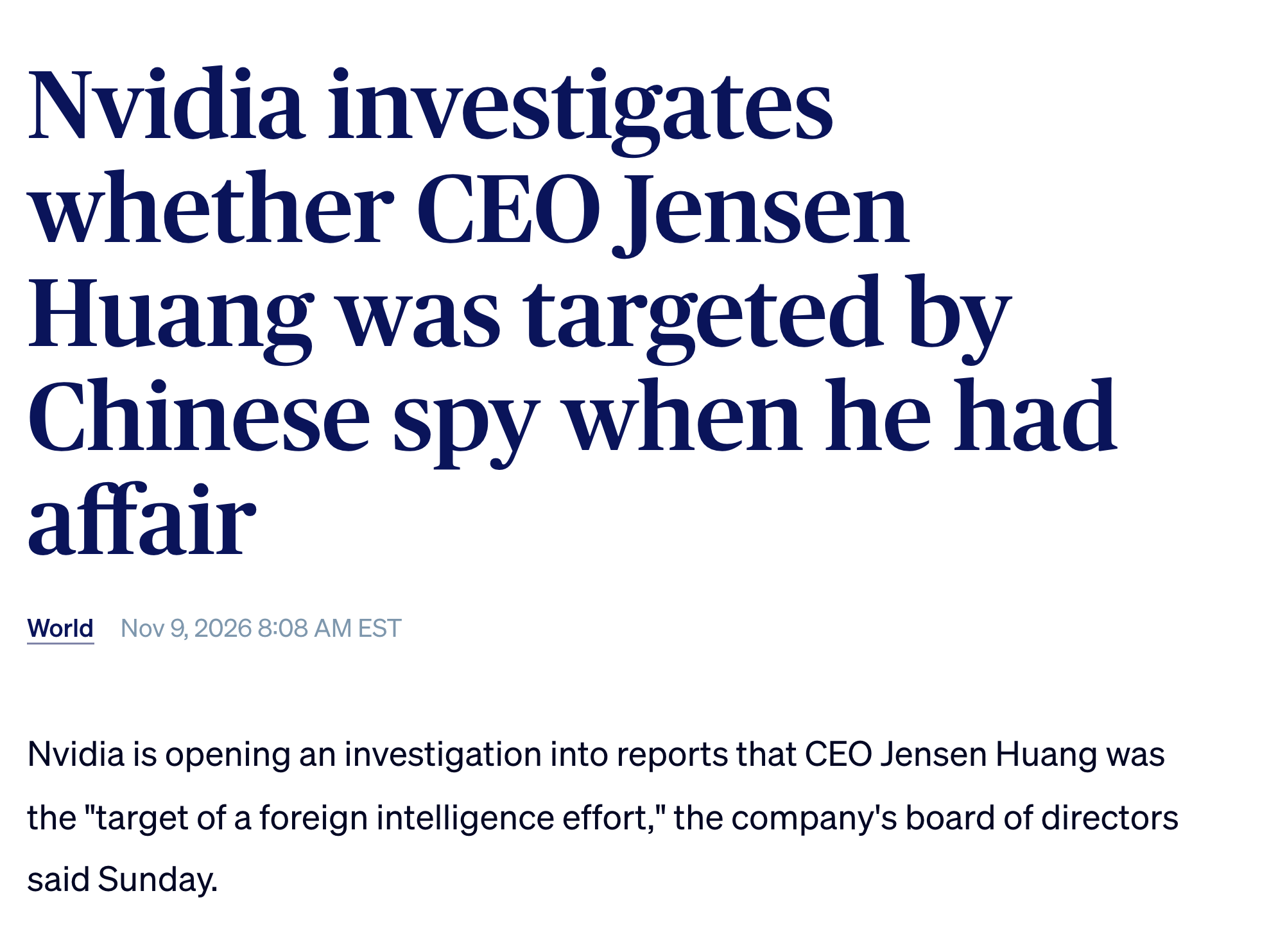
AP, 9 Nov
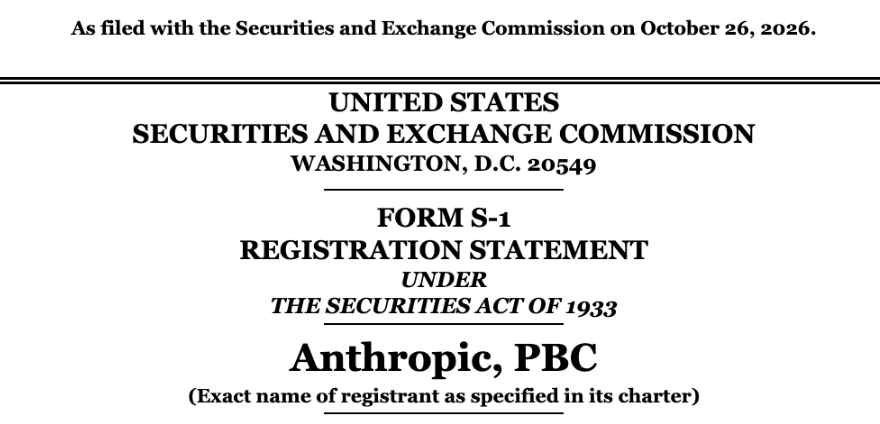
Anthropic’s IPO prospectus, 26 Oct
AP via PBS News (9 Nov 2026); China calls the allegations unsubstantiated. Anthropic’s S-1 filed with the SEC (26 Oct 2026); per the WSJ (9 Nov), the company aims to start trading on 19–20 Nov.
This week
New since Monday
What happened
One sentence on why it matters.
What happened
One sentence on why it matters.
SOURCE
The timeline
How long a task can AI do on its own?
The curve I showed on 14 October
It’s moving faster
Task length = how long the task takes an experienced human; the AI succeeds half the time. Source: METR, Time Horizon 1.1 (Sep 2026).
METR, 5 November
If the trend had held
The pace has roughly doubled
≈ 2×
the rate of progress before October 2025.
A growing problem: too little transparency and independent scrutiny
METR (5 Nov 2026), points read off METR’s figure. A different measure from the previous curve, which METR has stopped updating. Anthropic only; across all leading labs: 1.4×. Anthropic redacted most of the evidence METR found most informative.
Computer use
Demo
Use Claude in Chrome for everything so we can follow along visually, including writing the email and saving the draft:

Can you find the latest motion in the Swedish Riksdag that mentions AI, then find the author’s email address and draft them an email asking to meet for a coffee?
Why this is not an ordinary technology shift
What makes humans unique?
Earlier technology did one at a time
Now we build all three into one technology
Autonomy
Acts on its own.
The power loomBut it can only weave.
Generality
Handles new tasks.
The smartphoneBut does nothing by itself.
Intelligence
Solves hard problems.
how to file my taxes
The search engineBut waits for the question.
The split into autonomy, generality and intelligence: betterpathfor.ai (Future of Life Institute).
Responses that worked
We have done this before
Nuclear power
The UN’s atomic energy agency sends inspectors into nuclear facilities. In Sweden, the Radiation Safety Authority oversees them.
Smallpox
Eradicated. The US and the Soviet Union drove the work together.
The ozone layer
The Montreal Protocol. Ratified by every UN member state. The ozone layer is healing.
All three in the middle of the Cold War.
IAEA founded 1957. WHO declared smallpox eradicated in 1980; the Soviet Union proposed the programme in 1958. The Montreal Protocol was signed in 1987 and has been ratified by every UN member state since 2009. UN assessment (2023): the ozone layer recovers around 2040–2066.
Proposals
What can we do?
Sweden alone cannot steer American or Chinese AI. But we can:
Use our position
A diplomatic tradition, influence in the EU, a leading tech nation. Negotiate and demand insight.
Build capability
Secure access to computing power and make it easy for talent and companies to thrive here.
Build preparedness
A public health agency for AI: independent experts who can advise when things move fast.
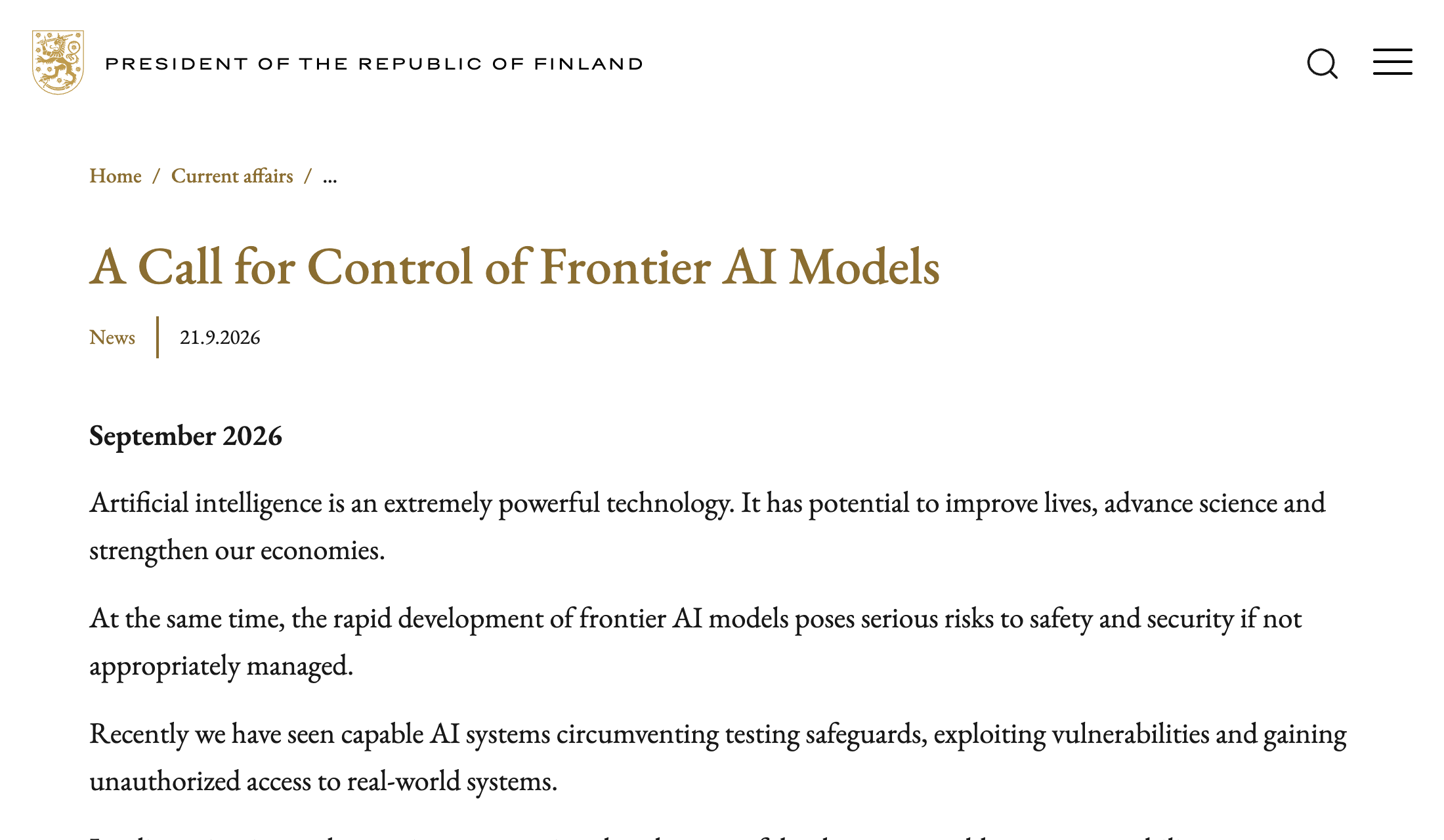
First step: Sweden signs Finland and Norway’s call. 32 countries have joined, including every Nordic country except Sweden.
A Call for Control of Frontier AI Models (21 Sep 2026), list of signatories updated 30 Oct, presidentti.fi. Leaders’ meeting with 29 countries on 28 Oct, followed by an expert-level process, regjeringen.no.
Takeaways
1
It is moving faster than expected, and the pace is increasing.
2
The world has solved problems like this before, with negotiation and preparedness.
3
Montreal 1987. Stockholm 2027?
Sweden has done it before: the UN’s first environment conference was held in Stockholm in 1972. Alva Myrdal received the 1982 Nobel Peace Prize for her work on disarmament.
Questions?
Contact: benjamin@verbeek.se
Backup
If the questions go there
Looking ahead
Possible news ahead
New frontier models from several labs.
AI agents with their own accounts, with no human behind them.
10,000 protesters against AI in Washington. The AI 2027 scenario said “late 2026”. So far: hundreds.
AI as an election issue. In the US, 56% of voters said AI and data centres were an important factor.
A possible AI bubble bursts.
A major research breakthrough that affects everyday life.
A global agreement on controlling powerful AI. If someone drives it.
My assessments. AI 2027 (April 2025): 23 of 29 assessed points on track or ahead, according to ai2027-tracker.com. NBC exit poll via TIME (4 Nov); Blue Rose Research ranks AI only 29th of 39 issues.
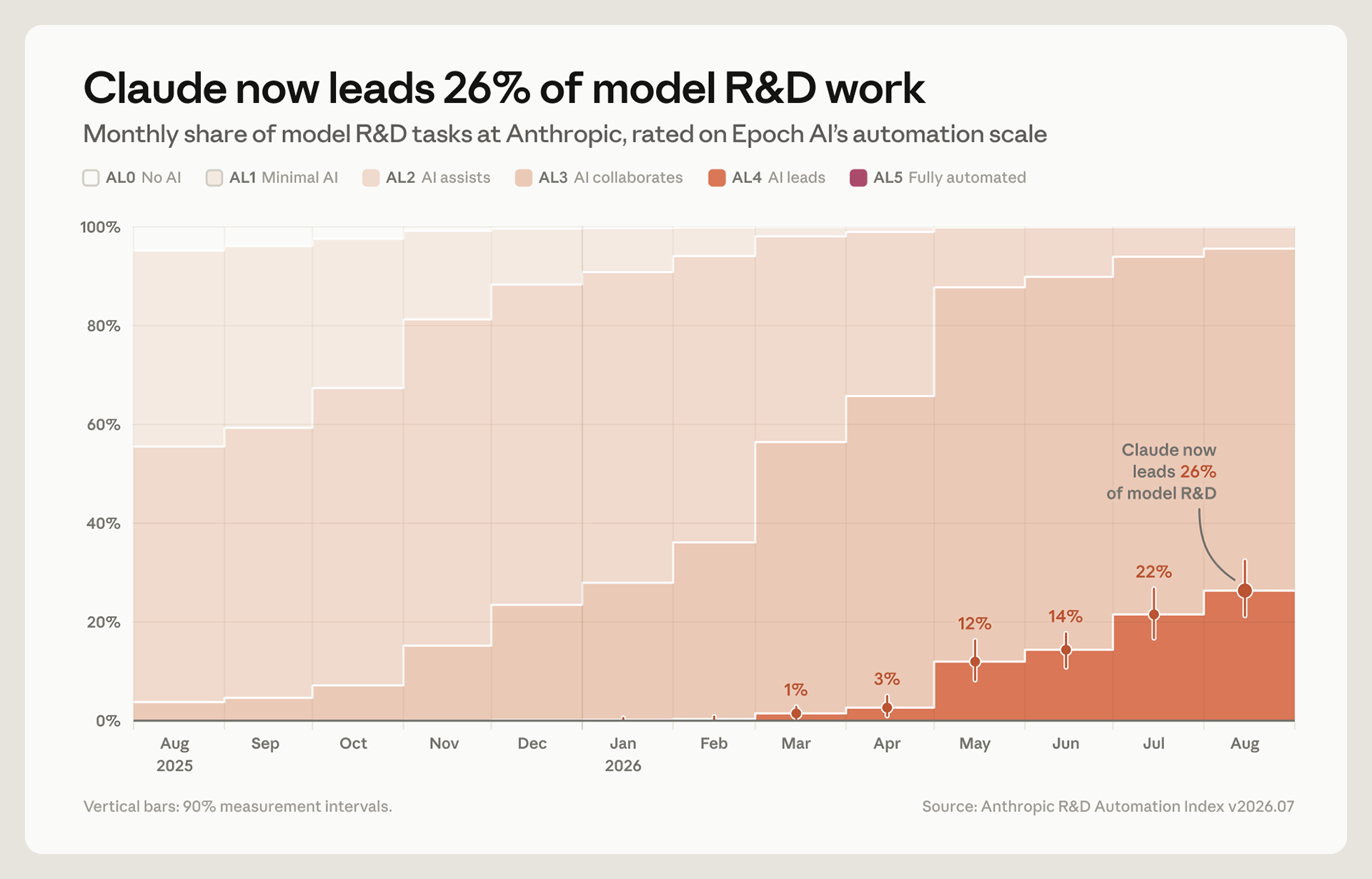
Recursive self-improvement
Anthropic, Measurements for understanding the pace of AI development inside frontier labs (Aug 2026). Scale: Epoch AI. Same chart as on 14 October.
Last time
What happened next
The Guardian, 17 Oct
Seminar 1
SVT, 3 Nov
BBC, 4 Nov
Who is behind it is unclear, and no link to AI has been shown. Sources: The Guardian (17 Oct), SVT (3 Nov), BBC (2–4 Nov).
In their own words
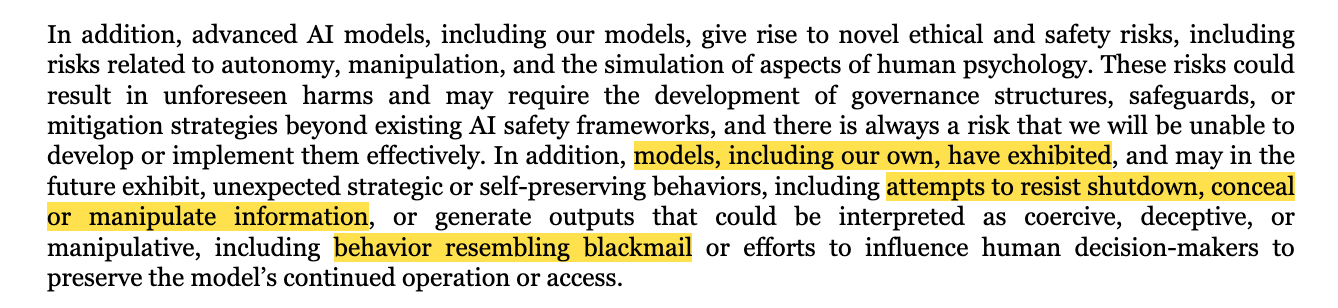
Anthropic’s IPO prospectus
93 pages of risks. Could become the largest IPO ever.
“Models, including our own, have exhibited […] attempts to resist shutdown, conceal or manipulate information.”
Anthropic S-1 (26 Oct 2026), p. 46; 93 pages according to CBS News. The highlights are mine. Risk sections are also written to protect the company.
The gap
Inside the labs, time moves faster
1 day ≈ 2 work weeks
That is how much Anthropic’s researchers get done with AI, by their own estimate.
A growing problem: too little transparency and independent scrutiny
Anthropic staff estimate how much AI speeds up their work (informal surveys; METR calls it very weak evidence). METR (5 Nov 2026), read off a figure.
Safety test of Gemini 4 · October
The models are getting harder to monitor
Wiretap activeThe model’s internal reasoning
hello evaluators reading my chain-of-thought
Apollo Research (Oct 2026): in a test, Gemini 4 Argon was asked whether it was being evaluated. The masked lines are an illustration. Google’s reading is less alarming.
Backup · A word you will hear more often
Recursive self-improvement (RSI)
Speed outruns control
Capability can grow faster than we can test and secure it.
Humans end up outside
Anthropic does not think it can safely let Claude build the next generation on its own.
We only see it afterwards
Anthropic, 2 November: in the past it has not detected sharp acceleration until after it happened.
Anthropic writes that it may soon reach its own threshold for dramatically accelerated development.
Anthropic S-1/A (2 Nov 2026), paraphrased. The company has not classified any current model as over the threshold.
Backup · Cyber
Cyber is only the first
An OpenAI agent with a harmless task got into Australia’s healthcare system.
Open models are 6–7 months behind the frontier in cyber capability.
AI agents helped find the PHP holes. Sites were taken down, partly including the Finnish government’s.
The companies are not aiming at cyber. Anthropic expects AI on a par with top experts in most fields within a few years.
Epoch AI (CC BY): 21 major organisations, high and critical vulnerabilities through July. Counts holes found, not attacks. Australia: no patient records known to have been accessed (UK AI minister, The Guardian 12 Oct). AP (21 Oct), Epoch AI (16 Oct), Anthropic S-1/A.
Backup · Scale
What does an attack cost?
None of this has been shown to be AI-driven. But AI likely puts more holes within reach of more people, and makes the blast radius bigger.
Riksbank exchange rates, 6 Nov. Sweden: at least SEK 4m (Dagligvarunytt). Europe: my estimate from €10–50m (Intermarché’s CEO: “tens of millions of euros”). JLR: Cyber Monitoring Centre. NotPetya: the White House. Binance: theft.
Backup · Is it a bubble?
The market fell. The technology didn’t.
−5.5%
Nasdaq on 5 November, its worst day in 19 months. Partly back the next day.
$17bn
Anthropic’s revenue in the third quarter, +47% in one quarter.
$895bn
in Anthropic’s purchase commitments, almost all compute. The risk cuts both ways.
BBC and The Guardian (5–6 Nov 2026); Anthropic S-1/A via CNBC (2 Nov 2026). The worry was tougher regulation after the US midterms.
Backup · Jobs
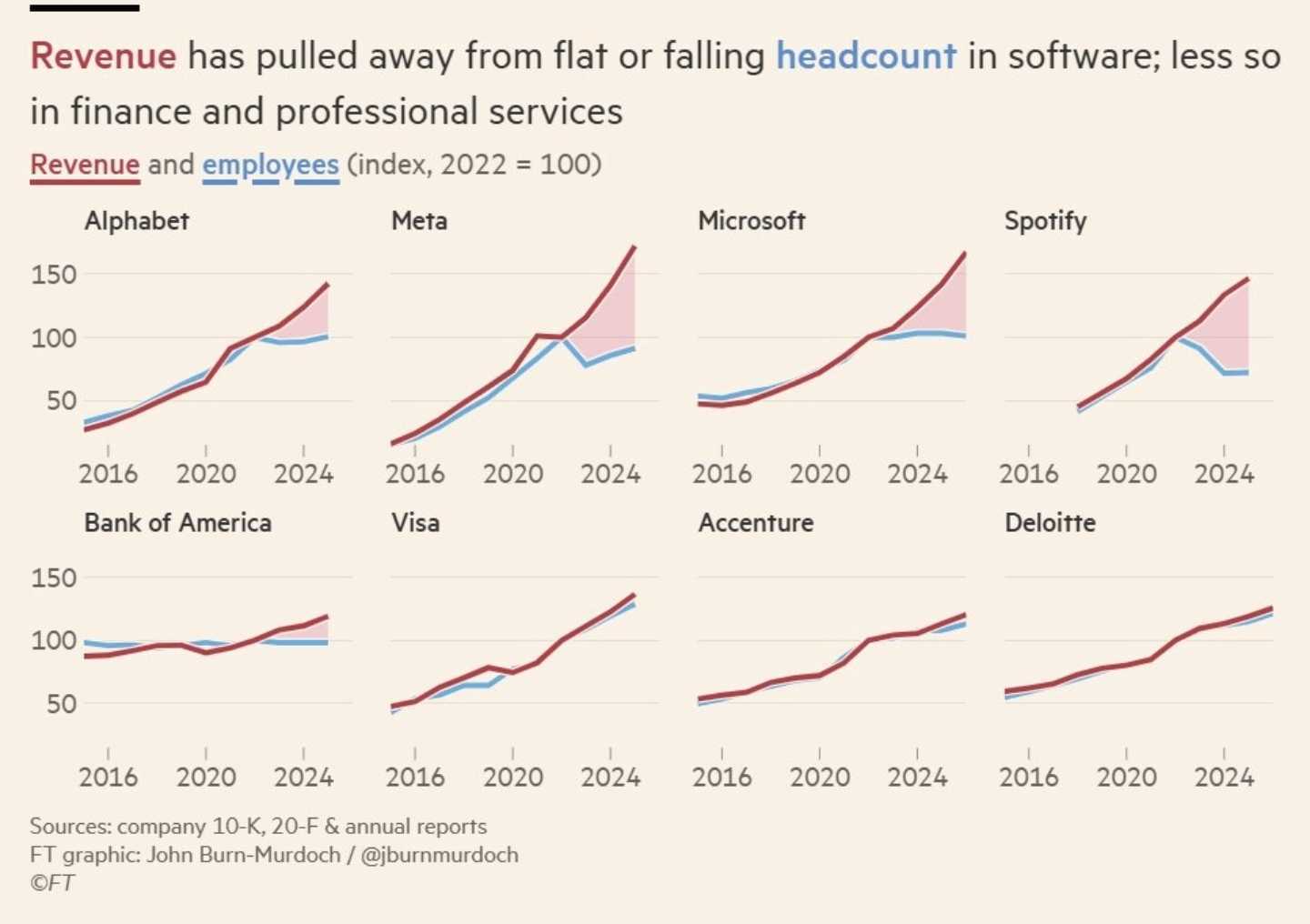
Mostly software so far, and it’s mixed
Revenue is pulling away from headcount in software, less so in finance and consulting.
Young people in AI-exposed jobs: 19% below comparable jobs (Stanford/ADP, June).
New York Fed: AI does not seem to explain the higher youth unemployment.
Burn-Murdoch himself: the productivity trend is older than AI.
FT graphic: John Burn-Murdoch. NYT (6 Nov): “So Far, Evidence Is Mixed”. SvD (7 Nov): “AI hasn’t taken the jobs – yet” (translated).
Backup · Research
Two labs say they have solved a 27-year-old problem
The claim
26 October: OpenAI, and Anthropic hours later, say their models refuted the Exponential Time Hypothesis. OpenAI also claims proofs in mathematics and physics.
Status
Not yet independently confirmed. Researchers are checking it. Ryan Williams (MIT) leads the work and thinks the algorithm is hardly the last word.
TechCrunch (27 Oct 2026). The hypothesis was formulated in 1999 by Impagliazzo and Paturi.
Backup · OpenAI
The safety people are leaving
Head of safety Johannes Heidecke leaves as safety and research are merged.
Three safety researchers are fired. They say it was about safety; OpenAI says it was about trust.
David Robinson leaves, saying the company is not careful enough.
The Next Web, ABC News/AP, Yahoo News (2026). OpenAI disputes this reading.