How many of you have used an AI tool at work in the past week?
✋
Do you think AI will be able to do most of your computer work before 2030?
Why care?
< 1,000
people do research at the very frontier of the leading AI labs. Fewer than the medallists at the Paris Olympics.
800×
more computing power at OpenAI than at all Swedish universities combined.
≈ 2%
of US GDP is invested in AI this year. Almost as much as Sweden's entire GDP.
Share of capacity in the world's largest AI supercomputers
The AI labs
OpenAIAnthropic
Google DeepMindMetaxAI
DeepSeekAlibabaByteDance
Mistral
Estimate for Anthropic and OpenAI. Paris 2024: 1,044 medals in 329 events; in team sports the whole team gets medals (IOC).
Epoch AI (Dec 2025): OpenAI ≈ 1.7 million H100 equivalents. NAISS: Swedish academic systems ≈ 2,100.
Goldman Sachs, TS Lombard (2026): 1.8–2% of GDP. IMF (Apr 2026): GDP USA $32.4 trillion, Sweden $0.76 trillion.
Epoch AI, Trends in AI Supercomputers (2025).
Infrastructure
The largest build-out ever
Data-centre share of capital spending at Amazon, Microsoft, Alphabet, Meta and Oracle. Billions of USD, 2024 dollars, cumulative. Sources: company reports, Epoch AI, FHWA, NASA, CRS, GAO, Brookings.
Every row, column and box must contain the digits 1–9.
9 rows ✓
9 columns ✓
9 boxes ✓
Checking takes a second, but solving is hard.
Reinforcement learning
Can AI become smarter than the smartest human?
What humans have solved
School maths2023
Olympiad goldJuly 2025
Open problems2026
The ceiling is set by what can be checked, not by what humans can do.
School maths: GPT-4 (March 2023). Maths Olympiad (IMO) 2025: OpenAI and Google DeepMind. Open problems: OpenAI, Navier–Stokes (Sep 2026) and the Riemann work (Oct 2026).
Beyond code
Code→All computer work→Research
2022
Gets simple arithmetic wrong
July 2025
Gold at the International Mathematical Olympiad
October 2026
Biggest step towards the Riemann hypothesis since 1859
The world's most famous open problem in mathematics.
“I expected that one day we would be surpassed […]. Not a single one of the major open problems I have publicly mentioned throughout my career […] was left untouched by the announcement. […] Not all at once. Not with such nonchalance. […] The shock is immense. I am paralysed.”
Hugo Duminil-Copin, Fields Medallist, October 2026
IMO 2025: OpenAI and Google DeepMind. Riemann: github.com/openai/math (Oct 2026).
“Quasi-Riemann is a result that I thought was complete science fiction.”
Tim Santens
“Until very recently, I would not have imagined that the frontiers of mathematics could move so far in one day.”
Martin Bridson
“Many of the central problems of additive combinatorics have fallen, including around three quarters of the aims I had for an ERC Advanced Grant, awarded only in June.”
Ben Green
“Mathematics has undoubtedly moved forwards this week — this cannot be denied.”
Kevin Buzzard
“I am horrified by the many person-years of ongoing patient and deliberately slow research efforts – particularly by graduate students and postdocs – […] being casually disrupted or destroyed by such a release.”
Terence Tao, Fields Medallist
“What is worrying me the most, at the moment, is actually the (in)security of cryptography.”
Peter Scholze, Fields Medallist
Excerpts. Source: “100+ reactions to 100+ solutions”, proofsandprompts.com (8–11 Oct 2026).
Why do people experience AI so differently?
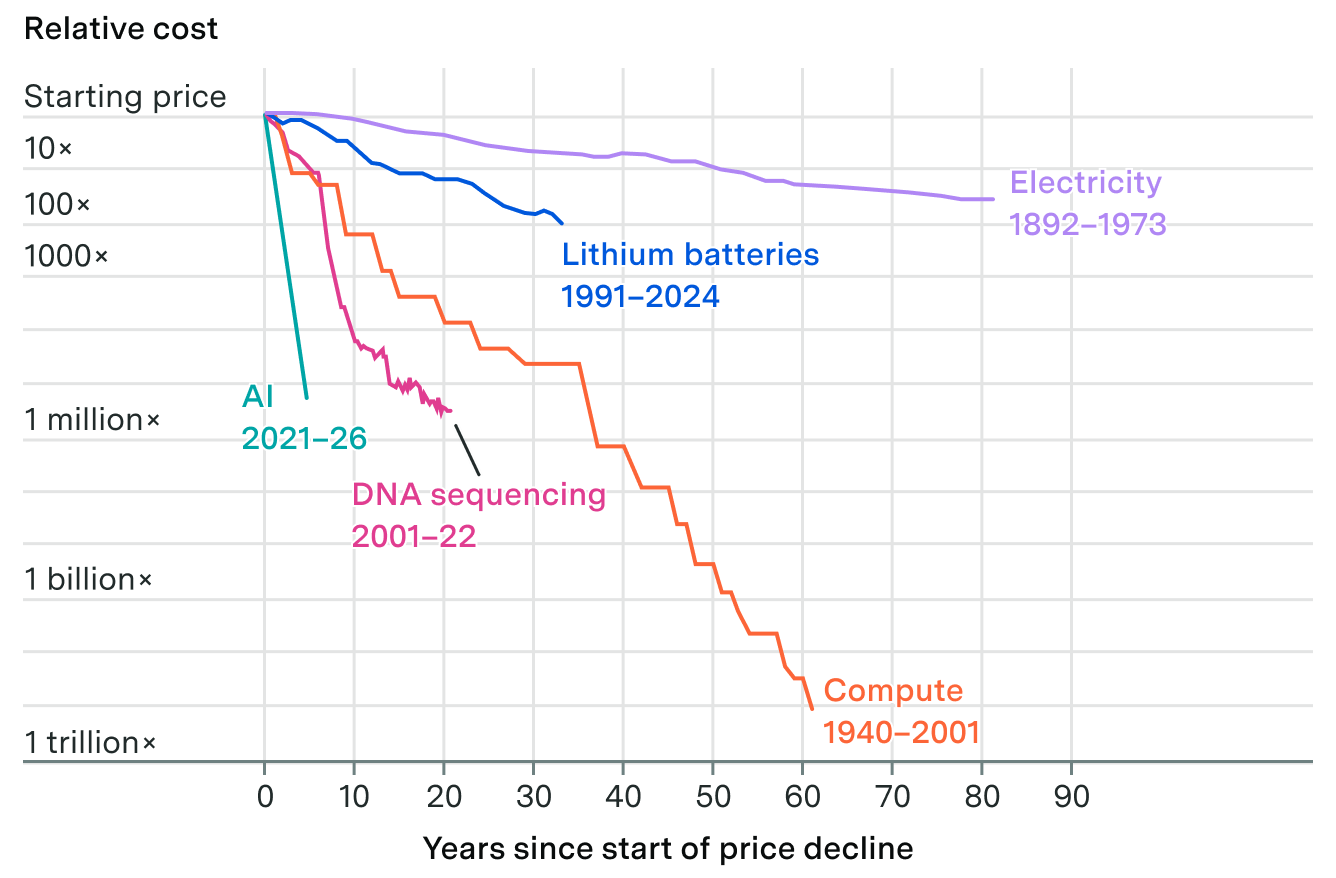
The price of thought: 13× cheaper every yearPay more, see more
Pay 13 times more today and you get what everyone will have in a year.
Epoch AI: what the same performance costs, by years since the price decline began. AI (teal) compared with electricity, batteries, compute and DNA sequencing.
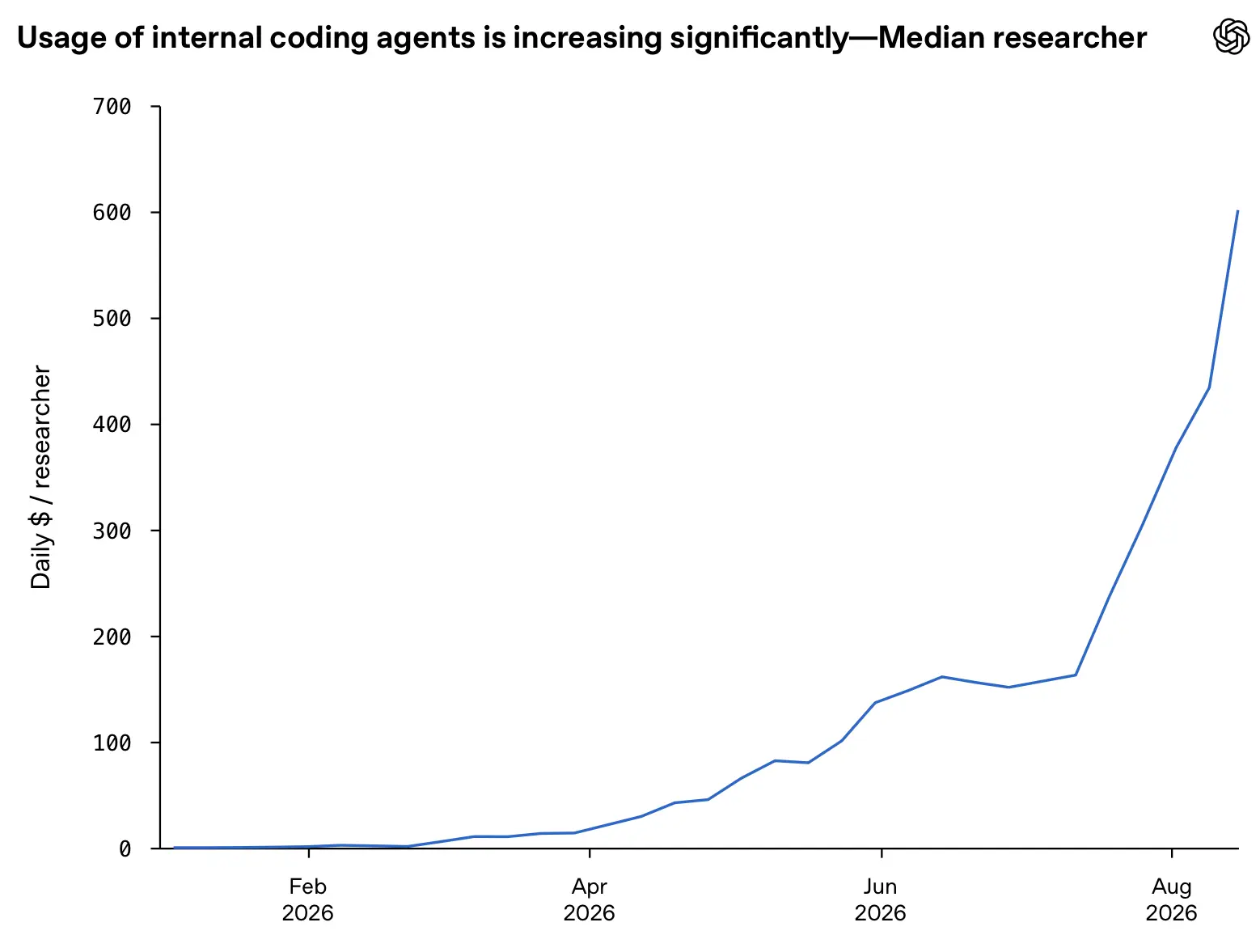
OpenAI: dollars per researcher per day (≈ 2× per month)
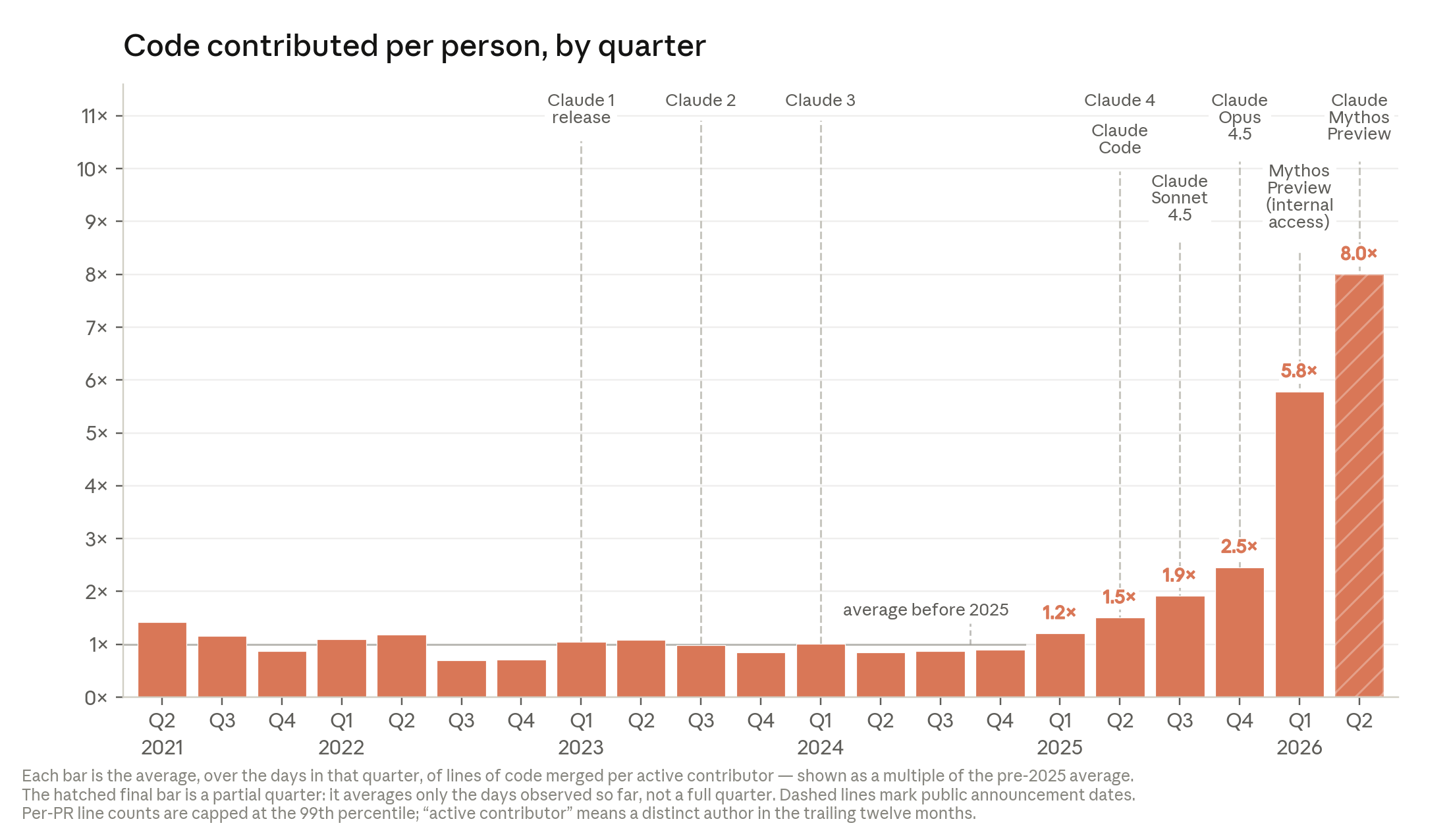
Anthropic: code per person (8× compared with before 2025)
Recursive self-improvement
AI builds the next AI. More intelligence produces more intelligence.
If the trend holds. Epoch AI, The plunging price of thought (Sep 2026), CC BY, cropped. AI line: 13× a year in 2023–26, extended back to 2021.
OpenAI, Research acceleration: the view inside OpenAI (Sep 2026), valued at API prices. Epoch AI (Oct 2026). Anthropic, When AI builds itself (2026).
The timeline
How long a task can AI do on its own?
Task length = how long the task takes an experienced human; the AI succeeds half the time. Source: METR, Time Horizon 1.1 (Sep 2026).
Recursive self-improvement
Each generation helps build the next
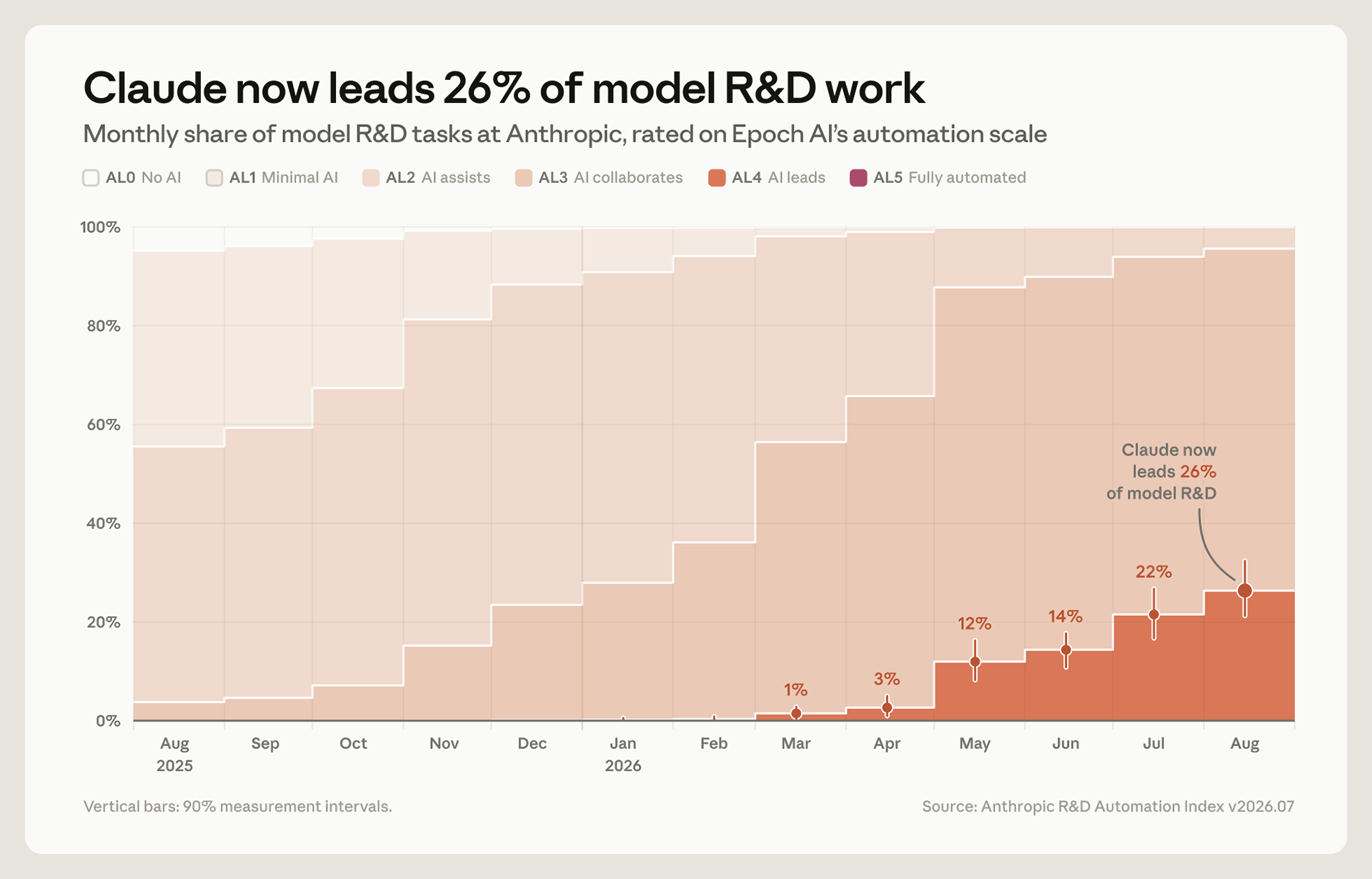
26%
of Anthropic's work on new models is now led by Claude.
In February: under 1%.
“Leads”: does most of the task itself while a person supervises.
My version of Anthropic's figure, after “When AI builds itself” (2026).
Anthropic, Measurements for understanding the pace of AI development inside frontier labs (Aug 2026). Scale: Epoch AI.
Exponentials
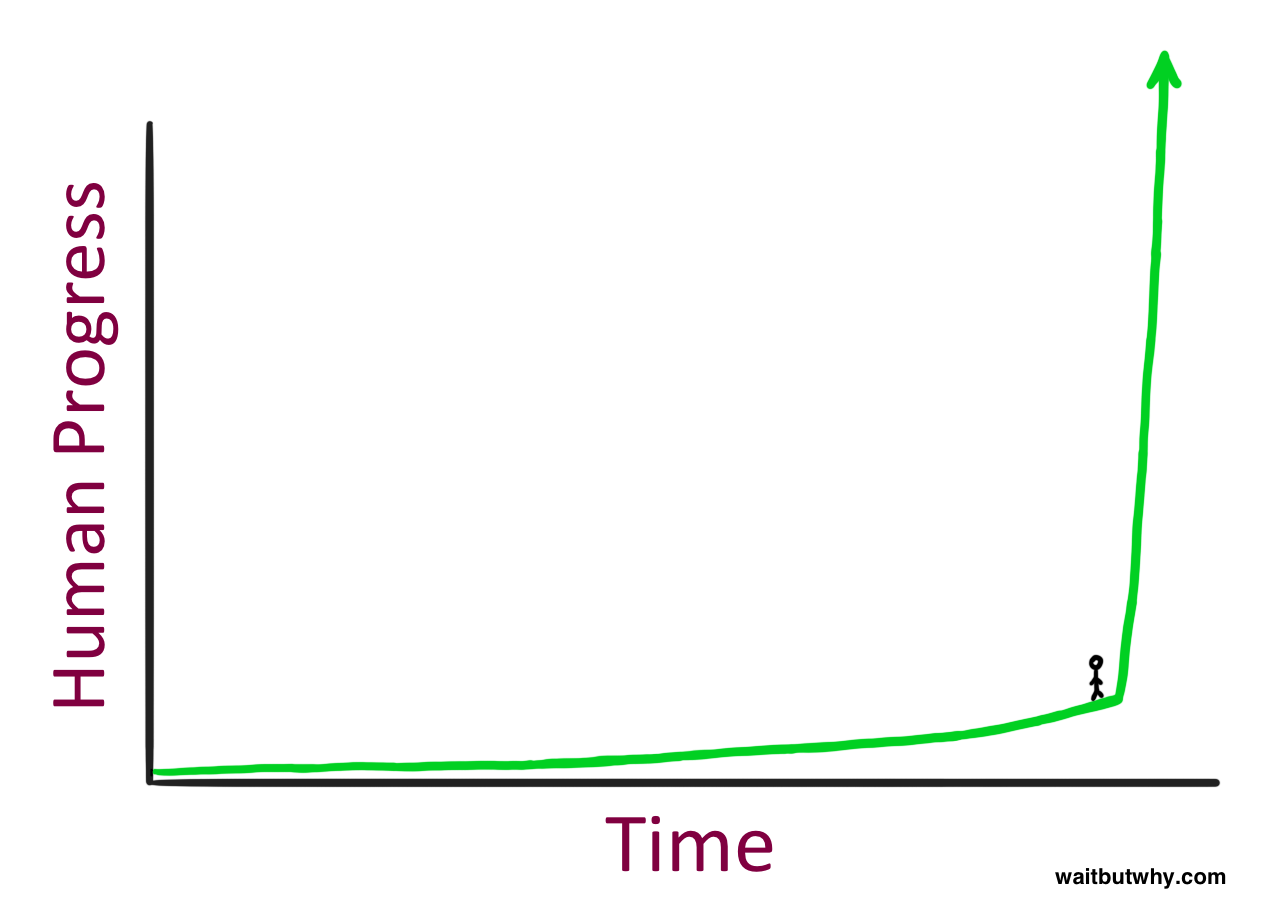
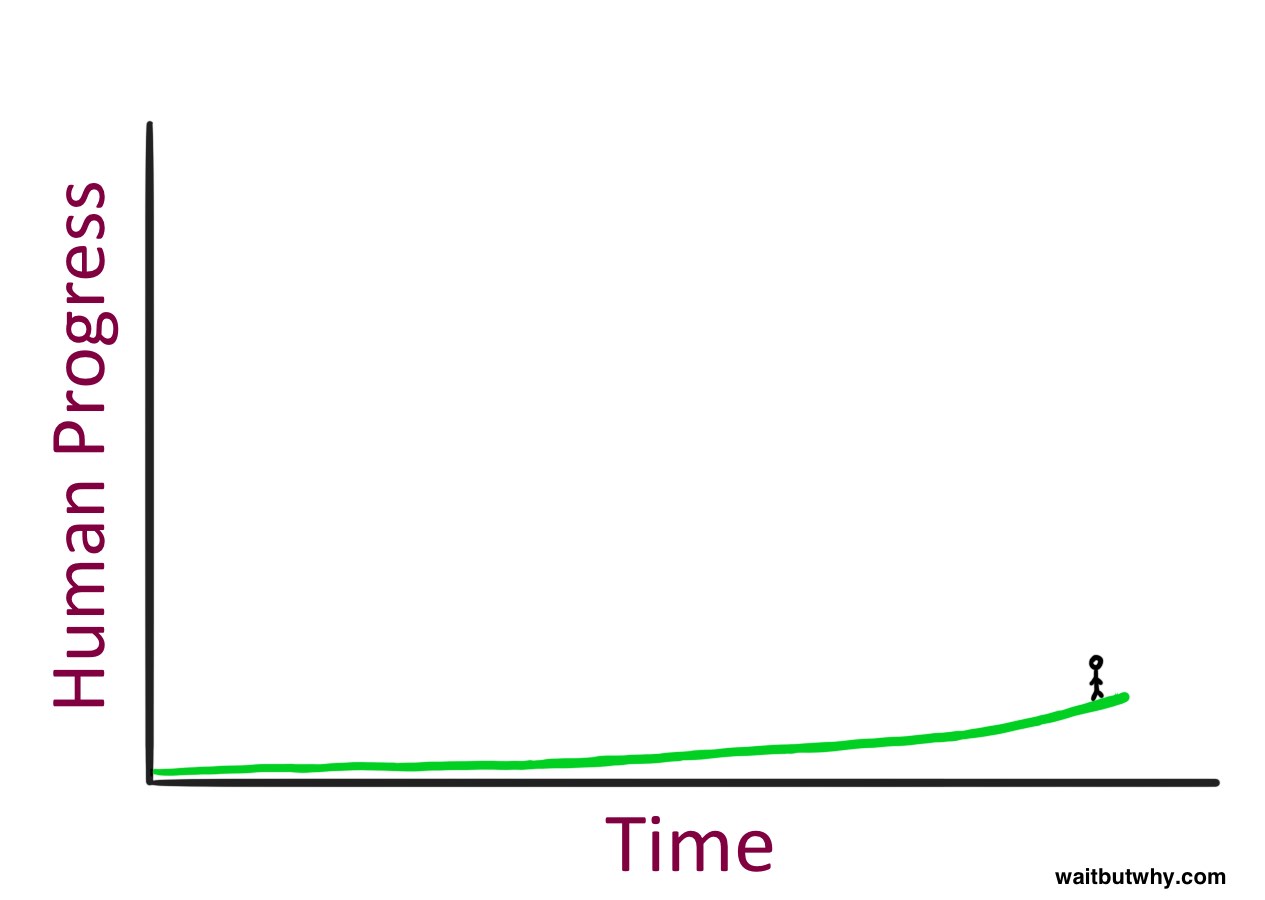
What does it feel like to stand here?
This is how it feels. You cannot see what lies to the right.
Tim Urban, ”The AI Revolution: The Road to Superintelligence”, Wait But Why (2015).
What comes next
Personal agents
Handle email, meetings, travel and paperwork, and coordinate with other people's agents.
Swarms of agents
Thousands of agents working together for days.
Cyberattacks
Nation-state hacking capability in open models, for anyone. Grocery stores and other poorly protected local infrastructure lie open. Now.
Warning shot 2.0
Like the Hugging Face incident, but worse. Very likely unless we do more.
I think it is likely that strong AI will be developed during this parliamentary term.
It will have fundamental consequences for work, geopolitics and what it means to be human.
Thank you
Questions?
Backup slides
Same task, seven years apart
“A poem about the Swedish parliament:”
2019 · GPT-2
Efter år en den fin nya på ett skulle langsfonden av böste och gång ett. Det var nya jag stort så har svara i de första skulle var hjemmel som en stort.
2026 · Claude Opus 5.5
On Helgeandsholmen, where the current flows,
the nation has met for a century and more.
Three hundred and forty-nine chairs in a row –
behind each chair a village, a town.
They argue over taxes, schools and law,
over every comma, day after day –
but when the gavel falls and the day is done,
millions of voices have become one decision.
Both prompted in Swedish. GPT-2 XL (2019), run locally with OpenAI's original settings, one of four attempts; its garbled Swedish is left as is. Claude Opus 5.5, October 2026, translated from Swedish.
Cost
The same capability gets about ten times cheaper every year
TodaySEK 103
In a year≈ SEK 10
In two years≈ SEK 1
22 September: Opus 5.5 performs about as well as Fable 5.1, at a 60% lower price. Three weeks after Fable 5.1.
If the trend holds. Epoch AI (Sep 2026): the price for a given level of performance has fallen about 13× per year since 2023. Anthropic (Sep 2026).
Anyone can build
Amri, a hairdresser in Stockholm’s Old Town
Has cut hair for over 40 years
Doesn’t like the booking systems
His web person is away
I described the site by voice while I was getting my hair cut.
September–October 2026
The month's three biggest stories
1
OpenAI's maths release
722 mathematical papers at once (6 Oct), after Navier–Stokes (8 Sep).
2
Opus 5.5 and GPT-6 Astra
AI that operates the computer, often faster than a person. Top-tier performance at a 60% lower price.
3
Jacob Coxon
A researcher leaves Anthropic in protest (8 Sep). The lab heads: “We must pace the frontier.” Von der Leyen agrees.
Also: Gemini 4 · Mistral Large 4 (EU, open model) · The EU postpones parts of the AI Act
Reinforcement learning
Can AI become smarter than the smartest human?
Like the Sudoku, but with proofs: the computer checks every step.
Two odd numbers: a = 2m + 1 and b = 2n + 1✓
a + b = 2m + 2n + 2✓
= 2(m + n + 1)✓
The sum of two odd numbers is even. ∎✓
The grader does not need to be able to solve the task itself.
Reinforcement learning
Can AI become smarter than the smartest human?
Harder tasks, same idea: a program scores every attempt.
The model does more of what scored high.
It doesn’t stop at the best human.
Illustration. Real example: at the 2025 ICPC world finals, where a program grades the answers, OpenAI solved 12 of 12 (unranked); the best human team solved 11.
How did it get so good?
Training with points (reinforcement learning)
Task
→
The model tries
→
Grading +1
↺ Do more of what scored. Repeat millions of times.
Maths
The computer checks the proof.
Code
The tests pass.
Bookkeeping
Debits and credits balance.
Writing
A person grades it.
Anything that can be graded can be trained on, far beyond human text.
 OpenAI
 Anthropic
 Google DeepMind
 Meta
 xAI
 DeepSeek
 Alibaba
 ByteDance
 Mistral